Hyperbaric Oxygen Therapy for Fibromyalgia
By Rohan Berg, FBCA ODX Specialist · Last reviewed July 2026
Hyperbaric oxygen therapy has the strongest evidence base of any environmental intervention in fibromyalgia. Two meta-analyses published in 2023 found large effect sizes on fibromyalgia impact and tender point count. The 2015 Efrati trial went further than symptom scores and imaged the brain. SPECT scanning showed the abnormal activity pattern seen in fibromyalgia, hyperactivity in posterior regions and reduced activity in frontal areas, moving towards normal after treatment. That is a mechanistic result rather than a questionnaire result.
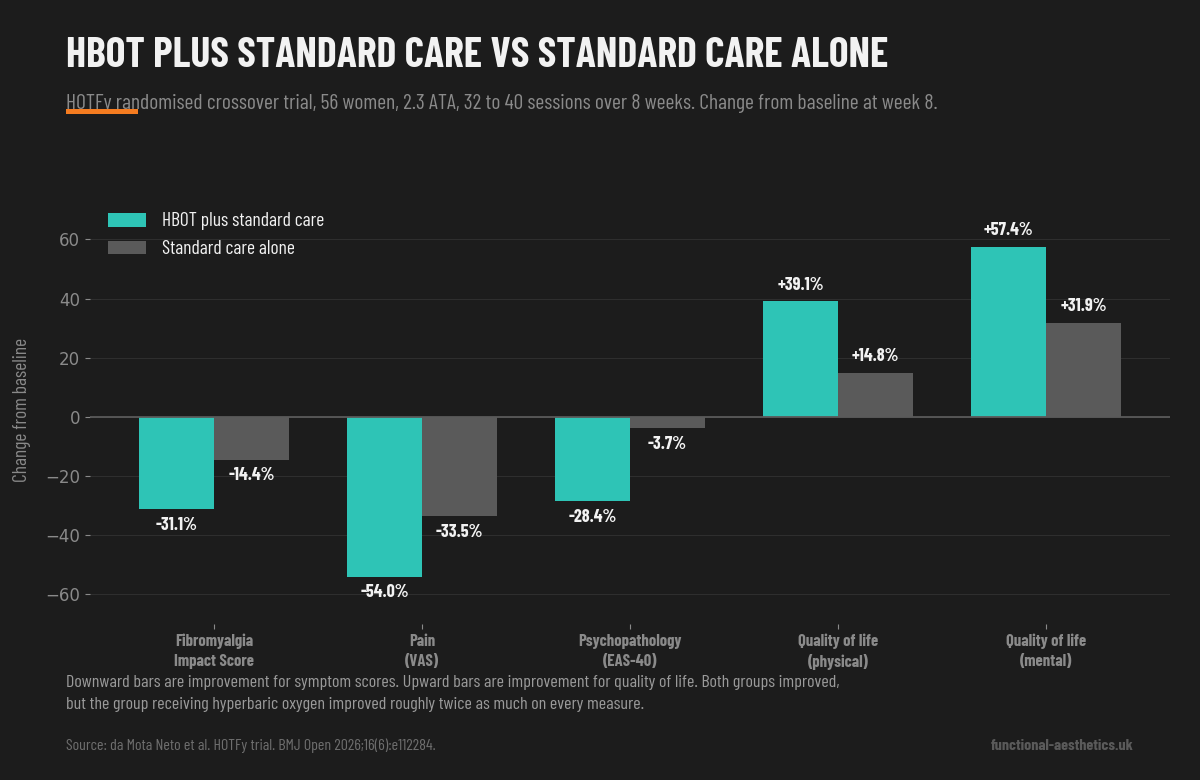
The HOTFy trial, published in BMJ Open in June 2026, tested hyperbaric oxygen as an adjunct on top of standard care rather than as a replacement for it. Fibromyalgia impact scores fell 31.1 per cent in the treatment group versus 14.4 per cent for standard care alone, roughly doubling the effect.
The evidence is not perfect. Blinding is the main methodological weakness, and side effects are more common than most providers admit. The trials producing the largest effects used pressures higher than most home chambers deliver. The page gives you all of it, including the parts that do not flatter the therapy.
Key takeaways
- Two independent meta-analyses in 2023 found significant benefit on fibromyalgia impact and tender point count with large effect sizes.
- SPECT imaging in the Efrati 2015 trial showed the abnormal brain activity pattern seen in fibromyalgia, hyperactivity in posterior regions and reduced activity in frontal areas, moved towards normal after treatment. A mechanistic result rather than a symptom score.
- The HOTFy trial, published in BMJ Open in 2026, tested HBOT as an adjunct to standard care. Fibromyalgia impact scores fell 31.1 per cent versus 14.4 per cent for standard care alone.
- Benefit appears to be exposure dependent. Some gains faded within weeks of stopping, others persisted for around eight weeks.
- The two meta-analyses disagreed on pain. One found a clear reduction, the other did not reach significance. That disagreement reflects methodological choices and is explained below.
- The published meta-analysis suggests pressure below 2.0 ATA may be preferable in fibromyalgia to reduce adverse events.
- Side effects are common. Around one in four participants reported one. About one in fifteen withdrew because of them. No serious adverse events were recorded.
- The biggest methodological weakness is blinding. Most trials could not fully blind participants, and fibromyalgia outcomes are self-reported.
Why would oxygen do anything for fibromyalgia?
Fibromyalgia is not a disease of the muscles or joints, despite where the pain is felt. It is a disorder of central sensitisation, meaning the central nervous system amplifies pain signalling. Alongside widespread pain, it produces fatigue, sleep disturbance, cognitive difficulty and autonomic symptoms.
That reframing is why an oxygen-based intervention became plausible. If the problem sits in brain function rather than peripheral tissue, then something capable of altering brain metabolism and neuroplasticity is at least worth testing.
The 2015 Efrati trial did more than record symptom scores. It imaged the brain. SPECT scanning showed the abnormal activity pattern seen in fibromyalgia, hyperactivity in posterior regions and reduced activity in frontal areas, moved towards normal after treatment. That is a mechanistic result rather than a questionnaire result, and it is the reason this literature is taken more seriously than most complementary therapy research.
The proposed pathways are neuroinflammation modulation, mitochondrial function, and neuroplasticity. The HOTFy authors describe all three.
What does the pooled evidence show?
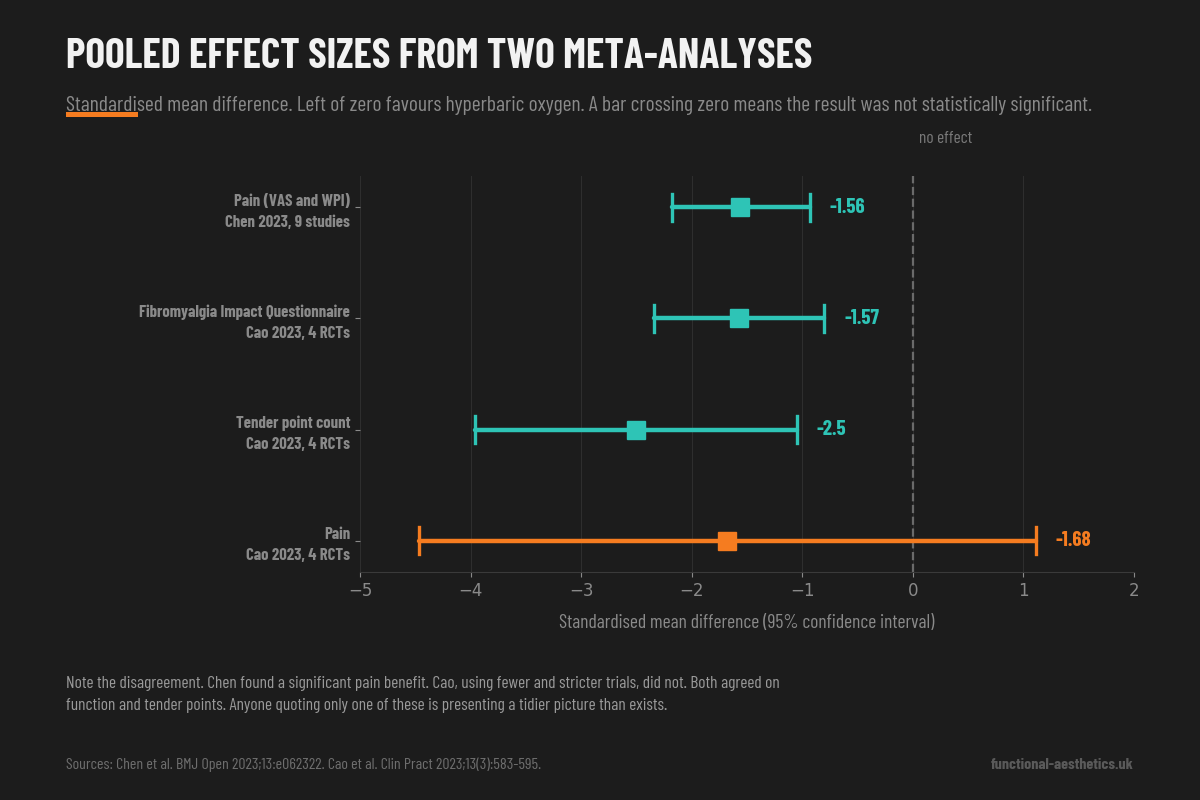
Chen and colleagues, BMJ Open, 2023. Nine studies, 288 patients. Combining visual analogue scale and widespread pain index results, they found a standardised mean difference of -1.56, with a confidence interval of -2.18 to -0.93 and a p value below 0.001. They also reported improvement in tender points, fatigue, multidimensional function, patient global assessment and sleep disturbance.
Cao and colleagues, Clinics and Practice, 2023. A stricter analysis restricted to four randomised controlled trials, 163 participants. Fibromyalgia Impact Questionnaire improved significantly, standardised mean difference -1.57. Tender point count improved significantly, -2.50. Pain did not reach significance, -1.68 with a confidence interval of -4.47 to 1.11 that crosses zero.
For context, a standardised mean difference above 0.8 is conventionally considered a large effect. These are well above that. But read the confidence intervals, not just the point estimates.
Why do the two meta-analyses disagree on pain?
This is the most useful question on the page, and almost no one covering this topic addresses it.
Chen included nine studies, both randomised and non-randomised. Cao included only four randomised controlled trials. Cao’s analysis is methodologically more conservative and produced a much wider confidence interval on pain, meaning greater uncertainty rather than evidence of no effect.
The honest reading is that pain reduction is likely but not established with confidence, while functional improvement and tender point reduction are more consistently supported. If someone quotes you the Chen pain figure without mentioning Cao, you are being shown a tidier picture than exists.
Want to know if this evidence applies to your situation? Send Rohan your question → Personal reply within 24 hours, no sales call, no consultation fee.
The newest trial, and why its design matters
HOTFy was published in BMJ Open in June 2026. It is the most useful trial in this literature for one specific reason: it did not test hyperbaric oxygen against nothing. It tested it as an adjunct on top of proper fibromyalgia care, meaning education, exercise and pharmacotherapy. That is how the therapy would actually be used.
Fifty-six women, randomised to receive hyperbaric oxygen either immediately or after an eight-week delay, at 2.3 ATA for 90 minutes, five times a week over eight weeks.
Three features of this trial deserve attention.
- The control group improved too. Standard care alone cut pain scores by a third. That is a reminder that exercise, education and medication are doing real work, and that hyperbaric oxygen is an addition to that, not a replacement for it.
- Timing did not matter. Starting immediately or after eight weeks produced equivalent results. This argues against the idea that there is a narrow window to catch.
- Benefit was exposure dependent. After stopping, fibromyalgia impact and mental quality of life drifted back towards standard care levels. Pain, psychopathology scores and physical quality of life held for around eight weeks. The authors suggest maintenance or booster schedules merit further evaluation.
The weakness you should know about
HOTFy was assessor-blinded, not participant-blinded. The 2015 Efrati trial used an active control crossover design rather than a sham chamber. Fibromyalgia outcomes are almost entirely self-reported.
Put those together and you have a real vulnerability. Participants generally know whether they have been sitting in a pressurised chamber for 90 minutes a day, and in a condition measured by questionnaires, knowing you are receiving an impressive-looking treatment can move the numbers on its own.
This does not invalidate the findings. The effect sizes are large enough that expectation alone is an uncomfortable explanation for all of it, and the SPECT imaging data is harder to explain that way. But it is why the evidence here should be described as promising rather than settled, and why a properly sham-controlled trial remains the outstanding priority.
Does pressure matter, and is lower pressure worse?
In most hyperbaric research, lower pressure is treated as a compromise. Fibromyalgia is one of the few areas where the published guidance points the other way.
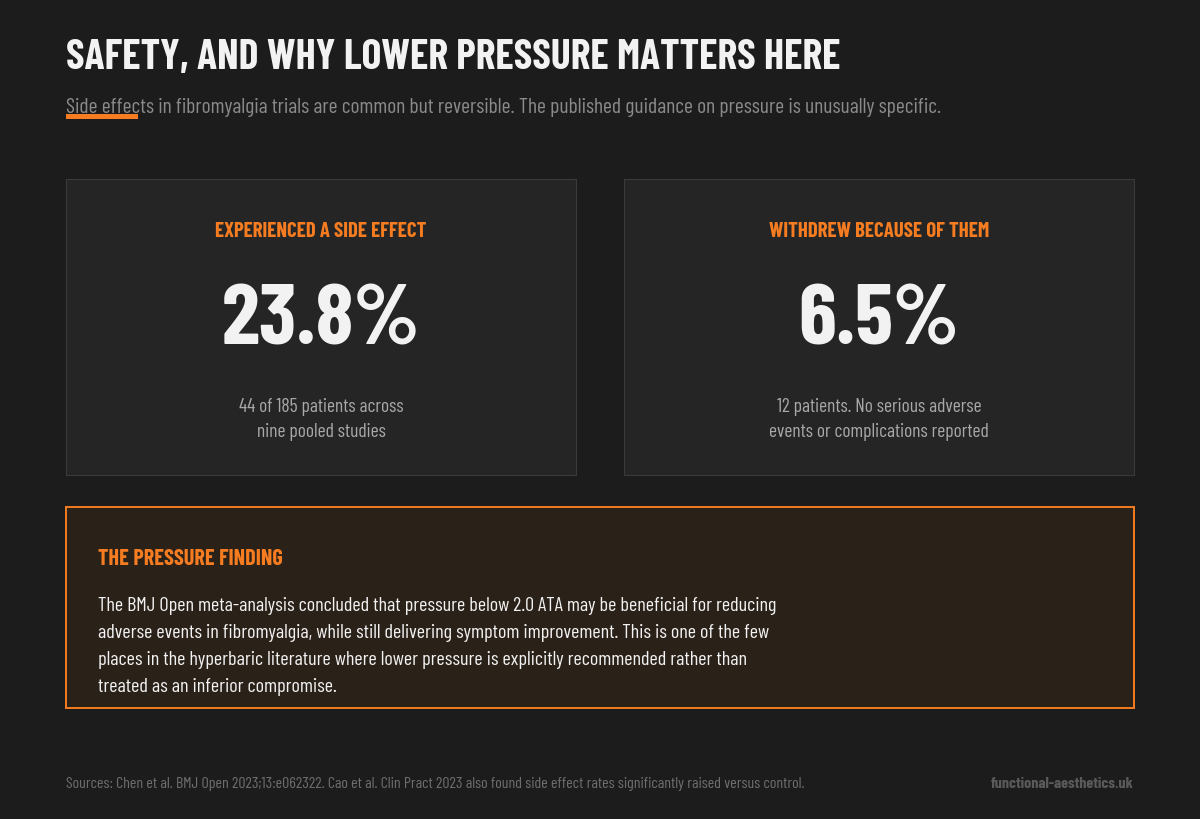
The Chen meta-analysis concluded that pressure below 2.0 ATA may be beneficial for reducing adverse events in fibromyalgia. Given that around a quarter of participants experienced a side effect and 6.5 per cent withdrew because of one, tolerability is not a trivial consideration. A protocol someone completes at lower pressure may be worth more than a protocol they abandon at higher pressure.
Be clear about what this does and does not establish. It is a recommendation about reducing harm, not a demonstration that lower pressure produces equal benefit. The trials with the largest effect sizes, Efrati at 2.0 ATA and HOTFy at 2.3 ATA, both used pressures at or above that threshold. Nobody has run a head-to-head trial comparing 1.5 ATA against 2.0 ATA in fibromyalgia.
The hyperoxic-hypoxic paradox
There is a mechanistic argument that absolute pressure may matter less than most people assume, and it comes from the leading hyperbaric research group rather than from marketing material.
Hadanny and Efrati described the hyperoxic-hypoxic paradox in 2020. Their argument is that cells respond to fluctuations in free oxygen concentration rather than to the absolute level. Repeated intermittent hyperoxia can therefore trigger many of the same regenerative mediators, including hypoxia-inducible factor pathways, that genuine hypoxia triggers. The signal is the change, not the ceiling.
If that model is right, it has a practical implication that is often missed. The fluctuation in Efrati’s protocols is created by air breaks within the session, cycling oxygen on and off, not by lowering the chamber pressure. Which means the variable worth attending to is session structure rather than session length. A longer continuous exposure at steady pressure does not create more transitions. It creates fewer per hour.
This remains a hypothesis about mechanism. It has not been tested as a dose-equivalence claim, and no trial has shown that a lower-pressure protocol matches a higher-pressure one in fibromyalgia. Treat it as a reason to be interested, not as a reason to be confident.
Side effects and who should avoid it
Across the pooled studies, 44 of 185 patients reported an adverse event, and 12 withdrew because of one. No serious adverse events or complications were observed. The Cao analysis found side effect rates significantly raised compared with control.
The commonly reported problems are ear pain or barotrauma on pressurisation, temporary short-sightedness over a course of sessions, sinus discomfort, and fatigue after sessions. In HOTFy, one case of otalgia required extended management, and withdrawals were mainly due to non-compliance or intolerance of chamber confinement.
Standard contraindications and cautions apply. These include untreated pneumothorax, certain lung conditions, recent ear or sinus surgery, active upper respiratory infection preventing equalisation, some chemotherapy agents, and uncontrolled seizure disorders. This list is not exhaustive and screening must be done by the provider. Tell them everything you take.
How would you know if it is working?
Fibromyalgia fluctuates. Symptoms vary with sleep, stress, weather, activity and flare cycles. Starting anything during a bad patch nearly guarantees you will feel better afterwards, whether or not the intervention did anything, because you were going to improve anyway.
Use the same instrument the trials used, so your result means something.
- 1Score the Revised Fibromyalgia Impact Questionnaire before you start. It is free, validated, and takes a few minutes. Your GP or rheumatology team will recognise it.
- 2Add a daily pain score out of ten and a daily sleep quality score. Do this for four weeks before session one.
- 3Repeat the questionnaire at the end of the course, then again eight weeks after stopping, because durability is the open question.
- 4Change nothing else at the same time if you can avoid it. New medication, a new exercise programme and a chamber all starting in the same week makes the result uninterpretable.
- 5Decide your stopping rule before you begin. HOTFy showed benefit within eight weeks. If you have completed a full course with no movement on the questionnaire, that is your answer.
Take the scores to your rheumatology team either way. A negative result recorded properly is worth more than a positive impression.
Frequently asked questions
Does the benefit last after you stop?
Partly, and this is one of the few places we have real data. In HOTFy, fibromyalgia impact scores and mental quality of life regressed towards standard care levels once treatment stopped. Pain scores, psychopathology scores and physical quality of life held their improvement for up to eight weeks. The authors described the durability as exposure dependent and called for evaluation of maintenance schedules. In plain terms: it is not a course you complete once and forget, and anyone implying otherwise is going beyond the data.
Is it better than exercise or CBT?
Nobody has tested that comparison. Every trial has used hyperbaric oxygen alongside or against usual care, never head to head against a single active alternative. Graded exercise and cognitive behavioural approaches have a larger and older evidence base in fibromyalgia and are recommended first. Hyperbaric oxygen has been tested as something you add, and that is how the evidence supports using it.
Can I do it alongside my medication?
HOTFy participants continued their pharmacotherapy throughout. That is the tested scenario. A small number of drugs do have specific hyperbaric contraindications, so give the provider your full medication list and let them screen properly. Do not stop or reduce prescribed medication in order to try this.
How many sessions before I would know?
The trials used 32 to 40 sessions over eight weeks, or 40 sessions over roughly two months. There is no evidence for short courses in fibromyalgia. If you are considering a package of ten sessions, understand that this is well below anything that has been tested and there is no basis for expecting the trial results from it.
Is 1.5 ATA enough?
Unknown, honestly. The meta-analysis suggests staying below 2.0 ATA reduces side effects, which is a point in favour. The trials producing the large effect sizes used 2.0 and 2.3 ATA. There is a mechanistic argument that fluctuation matters more than absolute pressure. Nobody has run the comparison. If a provider tells you 1.5 ATA is proven equivalent, they are stating something the literature does not contain.
What if I am claustrophobic?
Take this seriously before committing money. In HOTFy, withdrawals were mainly down to non-compliance or intolerance of chamber confinement, and the overall withdrawal rate was 21.4 per cent. Ninety minutes a day, five days a week, for eight weeks is a substantial commitment even for people who are comfortable in enclosed spaces. Ask to trial a single session before agreeing to a course or a rental term.
Does this apply to ME or chronic fatigue syndrome?
No. These are different conditions with different diagnostic criteria, and the fibromyalgia evidence does not transfer. Some people meet criteria for both, but that does not mean a fibromyalgia trial result tells you anything about ME. Treat any provider who blurs the two as a warning sign.
Why is it not available on the NHS?
NHS hyperbaric capacity is commissioned for established indications such as decompression illness, carbon monoxide poisoning and radiation tissue injury. Fibromyalgia is not among them. The evidence base, while positive, is small in total participant numbers and has the blinding limitations described above. That is the gap that would need closing before commissioning would be considered.
Functional Aesthetics is a UK longevity and health optimisation practice and we rent hyperbaric oxygen chambers for home use. That is a direct commercial interest in the subject of this page and you should factor it into how you read it.
Which is why the page states plainly that our chambers operate at 1.5 ATA, that the trials showing the largest benefit used 2.0 to 2.3 ATA, and that nobody has demonstrated those pressures are equivalent. We would rather tell you that than have you find it out afterwards.
What home access genuinely offers is the ability to complete a 32 to 40 session protocol, which is what the trials actually tested and what most people never finish when paying per visit at a clinic. Adherence is a real argument. Equivalence of pressure is not, and we will not make it.
Speak to your GP or rheumatology team before starting. Related reading: hyperbaric oxygen and recovery from burnout and overtraining. About the author: Rohan Berg, FBCA ODX specialist.
References
Clinical literature retrieved via PubMed.
- Efrati S, Golan H, Bechor Y, et al. Hyperbaric oxygen therapy can diminish fibromyalgia syndrome, prospective clinical trial. PLoS One. 2015;10(5):e0127012. doi:10.1371/journal.pone.0127012
- Hadanny A, Efrati S. The hyperoxic-hypoxic paradox. Biomolecules. 2020;10(6):958. doi:10.3390/biom10060958
- Chen X, You J, Ma H, Zhou M, Huang C. Efficacy and safety of hyperbaric oxygen therapy for fibromyalgia: a systematic review and meta-analysis. BMJ Open. 2023;13(1):e062322. doi:10.1136/bmjopen-2022-062322
- Cao C, Li Q, Zhang X, Varrassi G, Wang H. Effectiveness of hyperbaric oxygen for fibromyalgia: a meta-analysis of randomized controlled trials. Clin Pract. 2023;13(3):583-595. doi:10.3390/clinpract13030053
- Han X, He Y, Yuan X, Sun N, Liu X. Hyperbaric oxygen therapy for patients with fibromyalgia: a systematic review protocol. BMJ Open. 2023;13(6):e071092. doi:10.1136/bmjopen-2022-071092
- da Mota Neto J, Mendes AF, Magalhaes Martins AF, et al. HOTFy: randomised clinical trial for hyperbaric oxygen therapy in fibromyalgia. BMJ Open. 2026;16(6):e112284. doi:10.1136/bmjopen-2025-112284
This information is educational and does not constitute medical advice. It is not a diagnosis or a treatment recommendation and does not replace care from your GP or rheumatology team. Hyperbaric oxygen therapy is not an NHS-commissioned treatment for fibromyalgia. Never stop or reduce prescribed medication in order to try a complementary therapy. Always consult a qualified practitioner before beginning any new therapy.
Last reviewed July 2026. This page is maintained as an evidence resource and will be updated as new trial data is published.