HBOT for Recovery: An Evidence-Led Guide for Burnout and Overtraining
If you are reading this while running on empty, you already know the feeling. The training that used to build you now flattens you. Your sleep is broken, your morning resting heart rate has crept up, and the mental sharpness you rely on has gone foggy. On paper you are doing everything right, yet you are going backwards.
I have been there. A few years ago I pushed through the warning signs of overtraining and HPA axis dysregulation until my body forced the issue. What pulled me out was not more effort. It was better recovery, and a willingness to use the right tools at the right time. I wrote about that whole process in The Recovery Code, and HBOT was one part of it.
Hyperbaric oxygen therapy, or HBOT, is one of those tools. It is not magic, and it is not a shortcut. Used sensibly, alongside sleep, nutrition and load management, it may help your physiology do what it is already trying to do: repair, calm down and rebuild. This guide explains how it works, what the evidence does and does not support, and how high performers can think about using it.
What is HBOT?
HBOT involves breathing oxygen, usually at a higher concentration than normal air, inside a pressurised chamber. Two things change at once: the pressure around you rises above normal atmospheric pressure, and the air you breathe is richer in oxygen.
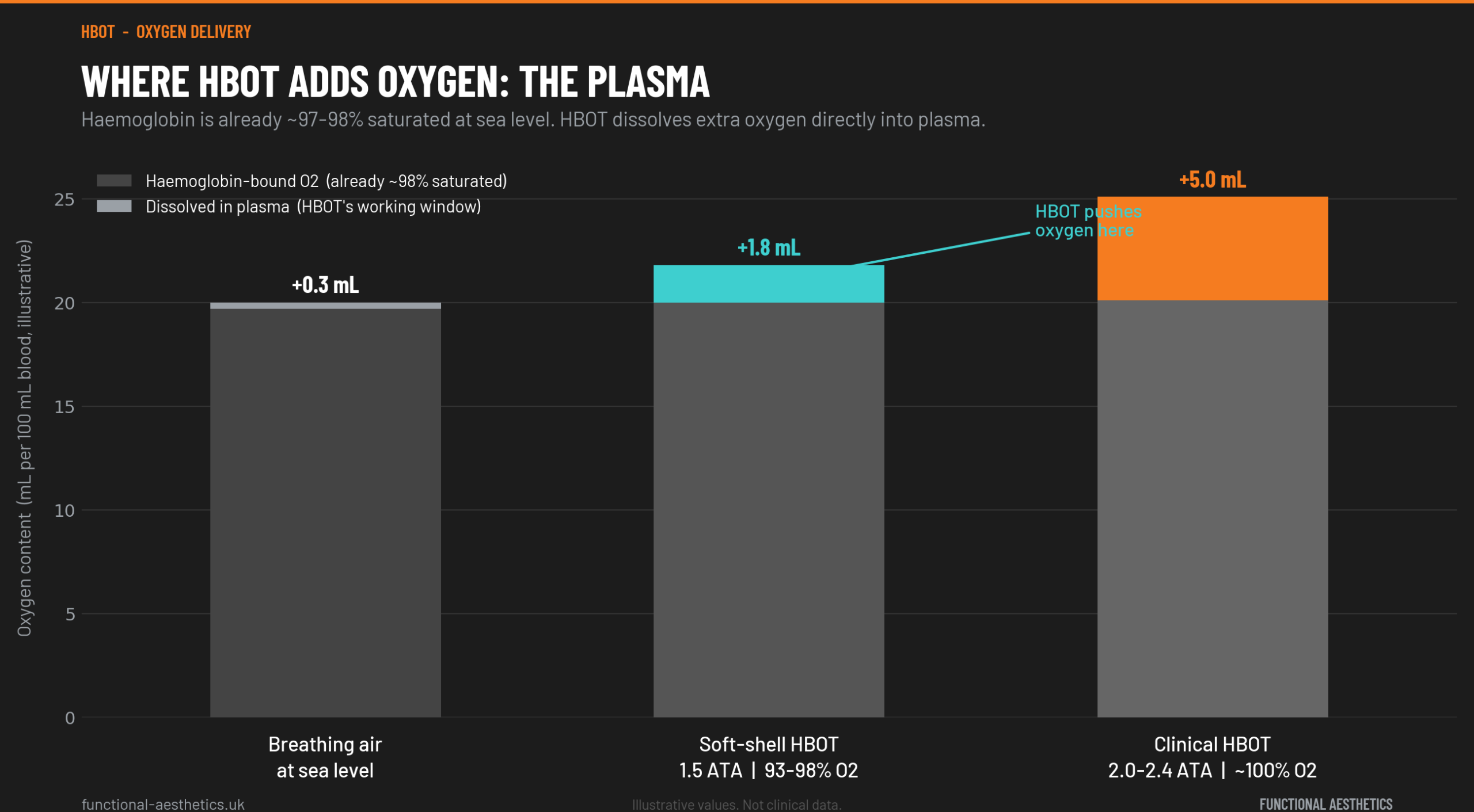
That combination matters. Under pressure, far more oxygen dissolves directly into your blood plasma, not just the oxygen carried by your red blood cells. The result is more oxygen reaching tissues, including areas where circulation is sluggish or inflamed.
Chambers vary, and the difference matters. Clinical hard-shell chambers run at higher pressures, often around 2.0 to 2.4 times atmospheric pressure (ATA) with close to 100 per cent oxygen. Soft-shell or portable chambers, the kind used for home recovery and wellness, run at gentler pressures, typically around 1.3 to 1.5 ATA. Most of the strongest published research uses the higher-pressure clinical setups, so keep that in mind as we go.
How HBOT works
Oxygen saturation and plasma diffusion
Normally, around 97 to 98 per cent of the oxygen in your blood is bound to haemoglobin inside red blood cells, and at sea level that system is almost fully loaded. Breathing more oxygen at normal pressure does little, because haemoglobin is already nearly saturated. Pressure changes the equation. Under hyperbaric conditions, oxygen dissolves into the plasma in much greater amounts, a relationship described by Henry’s law. This plasma-borne oxygen can diffuse into tissues independently of red blood cells, reaching areas that are poorly perfused.
Mitochondrial function
Mitochondria are the parts of your cells that turn oxygen and fuel into usable energy. When you are overtrained or burnt out, mitochondrial efficiency often suffers. By temporarily raising tissue oxygen availability, HBOT may support mitochondrial activity and cellular energy production. A 2024 review in Frontiers in Neurology describes HBOT influencing mitochondrial biogenesis and function as one of its core mechanisms (Bin-Alamer et al., 2024), and controlled animal work has shown it can upregulate mitochondrial biogenesis pathways (Hsu et al., 2022). Much of this mechanistic work is preclinical, so treat it as promising rather than proven in everyday recovery.
Neuroinflammation
Chronic stress and overtraining are associated with low-grade inflammation, including in the brain. HBOT has been studied for its effects on neuroinflammation and brain function, with reviews reporting reductions in inflammatory signalling such as TNF-alpha and IL-6 (Bin-Alamer et al., 2024). A randomised controlled trial in healthy older adults found HBOT improved cognitive function alongside measurable increases in cerebral blood flow (Hadanny et al., 2020), mostly using higher-pressure clinical protocols. The relevance to everyday burnout is plausible, but not yet proven.
Tissue repair and angiogenesis
One of the better-understood effects of HBOT is on tissue repair. A systematic review of human studies found that HBOT influences signalling involved in the growth of new blood vessels, including vascular endothelial growth factor (VEGF), a process called angiogenesis (De Wolde et al., 2021). Better blood supply means better delivery of oxygen and nutrients to recovering tissue.
HBOT for recovery and performance
Muscle recovery
After hard training, muscle tissue carries microdamage and local inflammation. Improved oxygen delivery may support the repair process and help clear the by-products of intense effort. Some studies suggest HBOT can reduce muscle soreness and speed perceived recovery, but the picture is genuinely mixed. A review of recovery methods in elite athletes concluded there was no substantial evidence that HBOT reliably enhances between-session recovery, and that many studies used untrained subjects doing unfamiliar exercise (Barnett, 2006). In short, be sceptical of strong claims here.
Nervous system recovery
Overtraining is as much a nervous system problem as a muscular one. A body stuck in sympathetic “fight or flight” dominance struggles to recover. The calm, enclosed, low-stimulation environment of an HBOT session, combined with steady breathing, may help shift the nervous system towards a parasympathetic, recovery-oriented state. Part of this benefit is likely the enforced stillness itself, an hour with nothing to do but breathe.
HRV improvement
Heart rate variability (HRV) is a useful window into nervous system balance and recovery readiness. Higher HRV generally reflects better parasympathetic tone. Research in related hyperbaric and hyperoxic settings has shown a shift towards parasympathetic (vagal) dominance during exposure (Lafere et al., 2021), which is mechanistically encouraging, though direct HBOT-and-HRV evidence in recovery is still limited and HRV is influenced by many factors. Treat any HRV change as one signal among several, not proof on its own. If you want to track yours against sleep and training load, our free Recovery Readiness Calculator is a simple place to start.
Cognitive performance
Brain fog is one of the most frustrating symptoms of burnout. Because the brain is highly oxygen-dependent, improved oxygen delivery and reduced neuroinflammation are plausible routes to clearer thinking. In a randomised controlled trial, higher-pressure clinical HBOT improved attention, information processing speed and executive function in healthy older adults (Hadanny et al., 2020). Extrapolating those results to mild, soft-shell sessions for general fatigue should be done cautiously, but the direction of travel is promising.
The table below summarises the direction of reported effects across common recovery markers. These are general, directional patterns drawn from the wider literature and clinical experience, not results from a single trial, and individual responses vary.
| Recovery marker | What it reflects | Reported direction with HBOT | Evidence strength |
|---|---|---|---|
| Muscle soreness (DOMS) | Local tissue damage and inflammation | May reduce | Mixed |
| Perceived recovery and readiness | Subjective fatigue and freshness | Often improves | Limited, mostly self-reported |
| Heart rate variability (HRV) | Autonomic balance | May improve over a course | Limited |
| Sleep quality | Recovery and nervous system state | May improve | Emerging |
| Cognitive clarity | Mental focus and processing | May improve | Stronger for clinical protocols |
| Inflammatory markers | Systemic inflammatory load | Tend to fall over a course | Emerging |
HBOT and inflammation
Inflammation is not the enemy. Acute inflammation is a normal and necessary part of adaptation: you train, you create a small controlled injury, your body repairs, and you come back stronger. The problem is chronic, low-grade inflammation that never switches off. That is the state many overtrained and burnt-out people get stuck in.
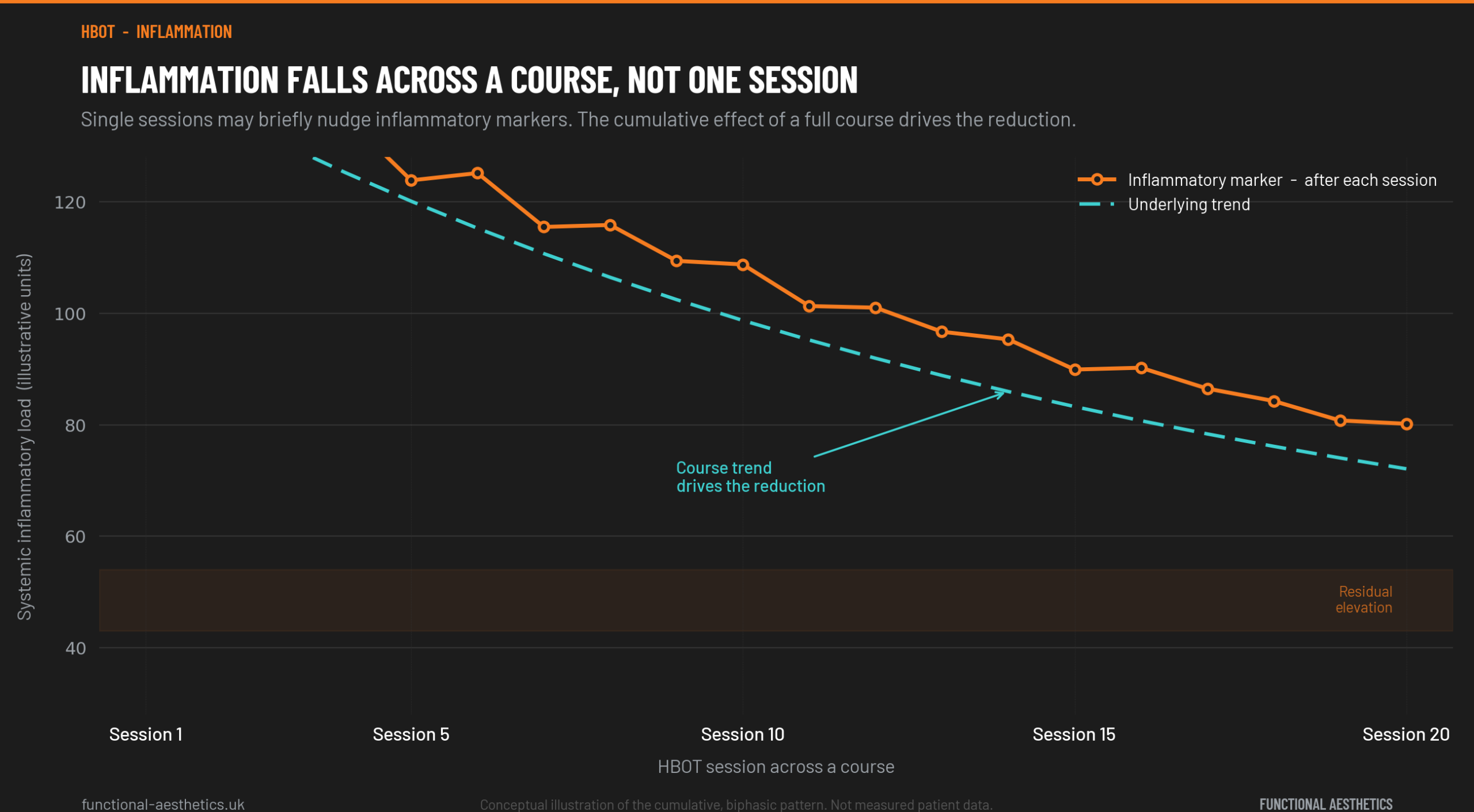
Cytokines are the chemical messengers that turn inflammation up or down. In simple terms, some (such as TNF-alpha and IL-6) can drive inflammation, while others help resolve it. HBOT appears to influence this balance, and its effects can be biphasic. A systematic review noted that markers may rise briefly after the first session or two, while the overall pattern across a course of sessions shifts towards reduced pro-inflammatory signalling and increased pro-angiogenic, pro-resolution activity (De Wolde et al., 2021).
Why does this matter for recovery? Persistent inflammation interferes with sleep, hormone signalling, mood and tissue repair. If you cannot resolve inflammation, you cannot fully recover, no matter how much you rest. Tools that help the body return to balance can therefore remove a hidden brake on recovery.
HBOT for burnout and overtraining syndrome
This is the section that matters most for high performers, so I want to be both useful and honest. There is strong mechanistic logic for HBOT in burnout and overtraining, but very little direct clinical trial evidence in these specific conditions. What follows is a reasoned case, not a settled one.
Allostatic load
Allostatic load is the cumulative wear and tear of chronic stress. Every stressor, whether training, work, poor sleep or life pressure, draws from the same recovery budget. Overtraining and burnout are what happen when withdrawals outpace deposits for too long. Anything that genuinely supports recovery helps reduce that load. HBOT’s potential contributions, better tissue oxygenation, lower inflammation and enforced parasympathetic downtime, all act on the recovery side of the ledger.
Nervous system dysregulation
A hallmark of overtraining is a nervous system stuck in overdrive: elevated resting heart rate, suppressed HRV, broken sleep and a wired-but-tired feeling. Recovery requires shifting out of chronic sympathetic dominance. The HBOT environment can encourage this shift, partly through the physiology and partly through the simple act of lying still and breathing for an hour with no screen and no demands.
Hormonal disruption
Chronic stress dysregulates the HPA axis, the system that governs cortisol and your stress response. Overtraining commonly shows up as a disrupted cortisol rhythm and a falling testosterone-to-cortisol ratio, a marker of an overstressed, catabolic state. HBOT does not directly “fix” hormones, and I would be wary of anyone claiming it does. What it may do is support the upstream conditions, lower inflammation, better recovery and improved sleep, that allow the HPA axis to recalibrate over time. If you want to see what your own stress and recovery biology is actually doing, a functional blood chemistry analysis is a more reliable guide than how you feel on any given day.
Who benefits most?
- Overtrained athletes whose performance has plateaued or declined despite adequate, or even reduced, training
- Burnout professionals dealing with chronic fatigue, broken sleep and mental fog
- Masters athletes (aged 35 and over) who recover more slowly and need to protect hard-won adaptation
- Anyone with persistent brain fog or cognitive fatigue linked to stress or overreaching
One caveat: anyone with an active contraindication should not use HBOT until cleared by a qualified practitioner. The risks section below explains why.
Practical application
Protocols vary widely, and the right approach depends on the chamber, the goal and the individual. The ranges below are general and educational, not a prescription. Work with a qualified practitioner to set yours. If you want daily access without living at a clinic, a soft-shell chamber home rental makes a consistent block of sessions far more practical.
- Session length: most recovery sessions run 60 to 90 minutes.
- Pressure: soft-shell wellness chambers typically operate around 1.3 to 1.5 ATA; clinical hard-shell protocols run higher, around 2.0 to 2.4 ATA.
- Frequency: benefits appear to be cumulative, so regular sessions tend to make more sense than occasional one-offs.
- Consistency over intensity: a steady, sustainable routine beats sporadic long sessions.
| Goal | Typical session length | Typical frequency | Notes |
|---|---|---|---|
| Acute recovery block (after an event or heavy overreaching) | 60 to 90 minutes | Several sessions per week for a short block | Short, focused use around peak load |
| Burnout or overtraining recovery phase | 60 to 90 minutes | Regular sessions across several weeks | Pair with sleep, nutrition and reduced load |
| Maintenance and general optimisation | 60 minutes | Occasional, ongoing | A top-up once recovered, not a daily must |
If you would rather have the whole picture interpreted for you, our High Performer Package combines genetic analysis, functional blood panels and practitioner consultations so any HBOT protocol sits inside a plan built around your actual biology.
When not to use HBOT
Always check with a doctor or qualified practitioner before starting. HBOT is not appropriate for everyone. Situations that require caution or rule it out include:
- An untreated pneumothorax (collapsed lung), which is an absolute contraindication
- Certain ear, sinus or upper respiratory conditions that prevent safe pressure equalisation
- Some chemotherapy agents (for example bleomycin) and certain other medications
- An uncontrolled high fever, some seizure disorders, or recent ear surgery
- Severe claustrophobia, which is about tolerance rather than safety, but still matters
This is not a complete list. Proper screening by a qualified practitioner is essential before any course of sessions.
Risks, limitations and misconceptions
- Ear and sinus discomfort (barotrauma) is the most common issue. Good equalising technique and sensible pacing reduce it.
- Oxygen toxicity is a risk at high pressures and long durations, but is uncommon at the gentle pressures used in wellness chambers.
- Claustrophobia. Some people simply find an enclosed chamber uncomfortable.
- It is not a magic bullet. HBOT cannot out-run poor sleep, chronic under-recovery or an unmanaged training load.
- Evidence gaps. Much of the strongest research uses higher-pressure clinical protocols for specific medical conditions. Evidence for mild, soft-shell HBOT in recovery and burnout is still emerging. Be honest with yourself about that.
- Cost and time. Sessions take time and money. Factor that in when deciding whether HBOT earns its place in your routine.
Should I use HBOT? Your questions answered
These are the questions I get asked most often by people weighing up whether HBOT is worth their time and money. Read them as a decision aid, not a prescription.
Should I use HBOT for burnout or overtraining?
It can be a useful addition if, and only if, your foundations are already in place. If your sleep, nutrition, stress and training load are still a mess, sort those first, because HBOT cannot compensate for them. Once the basics are handled and you are still stuck, the mechanistic case for HBOT (better tissue oxygenation, lower inflammation, enforced parasympathetic downtime) makes it a reasonable tool to trial.
Do I need a clinical hard-shell chamber, or is soft-shell enough?
Most of the strongest published evidence comes from higher-pressure hard-shell protocols (2.0 to 2.4 ATA). Soft-shell wellness chambers (1.3 to 1.5 ATA) are gentler, and the direct evidence for recovery and burnout at those pressures is still emerging. For general recovery, nervous system downtime and consistency at home, soft-shell is a sensible and practical choice. For specific medical conditions, that is a conversation for a clinician.
How many sessions before I notice anything?
The anti-inflammatory and recovery effects appear to be cumulative rather than instant. Think in terms of a consistent block of sessions across several weeks, not a one-off. Judge it against tracked markers such as sleep, resting heart rate and HRV rather than how you feel on any single day.
What does an HBOT session actually feel like?
Most people find the first few minutes slightly odd and the rest unremarkable. As the chamber pressurises you feel your ears wanting to equalise, much like a plane taking off or landing, which you manage by swallowing or gently yawning. At pressure it is quiet and still, and you simply rest, breathe or listen to something. Coming back down takes a few minutes at the end. If enclosed spaces make you uneasy, choose a chamber with a viewing window and have someone nearby for your first session.
Can HBOT replace rest and proper recovery?
No. This is the most important point in the whole guide. HBOT works with the fundamentals, not instead of them. It may help your body do its repair work more effectively, but it cannot out-run poor sleep, chronic stress or an unmanaged training load. Treat it as one instrument in the kit, not the whole orchestra.
Who should not use HBOT?
Anyone with an untreated pneumothorax (an absolute contraindication), certain ear or sinus conditions, some seizure disorders, an uncontrolled fever, recent ear surgery, or who is taking specific medications such as bleomycin. Severe claustrophobia is about tolerance rather than safety, but still matters. Always get screened first, this is not a complete list.
How do I know if HBOT is actually working for me?
Track a baseline before you start and review it objectively. Resting heart rate, HRV, sleep quality and training readiness are the practical everyday markers; inflammatory and hormonal markers on a blood panel give a deeper read. Our free Recovery Readiness Calculator is an easy starting point, and a functional blood chemistry analysis adds the biochemical layer.
Is it better to rent a chamber or pay per session?
Because benefits are cumulative, the maths usually favours consistent access. Single clinic sessions add up quickly and are easy to skip when life gets busy. If you are committing to a proper block of sessions, a home rental tends to be more cost-effective and far easier to stick to, which is what actually drives results.
Can I train or work during a session?
Sessions run 60 to 90 minutes, and many people use the time to read, work or simply rest. For recovery purposes there is a real argument for doing nothing at all, since the enforced stillness and slow breathing are part of the parasympathetic benefit. If you are using HBOT specifically to down-regulate a wired nervous system, resist the urge to fill the time.
Does HBOT help with brain fog and sleep?
These are among the more promising areas. Improved oxygen delivery and reduced neuroinflammation are plausible routes to clearer thinking, and clinical HBOT has improved cognitive measures in trial settings. Better sleep is commonly reported and mechanistically sensible, though the formal evidence is still emerging. Track both against your own baseline rather than assuming they will improve.
Final takeaway
The hardest lesson I learned from my own burnout is that recovery is not the reward for training. It is part of the training. More effort was never going to fix a problem caused by too much effort.
HBOT, used well, is a recovery tool. It is not a substitute for the fundamentals of sleep, nutrition, stress management and intelligent load. But for high performers who already have those basics in place and are still struggling to recover, it may be a useful addition that helps the body do its repair work more effectively. Treat it as one instrument in the kit, not the whole orchestra.
Three key takeaways
- HBOT raises the oxygen dissolved in your blood plasma, which may support tissue repair, reduce inflammation and aid recovery.
- The strongest evidence comes from higher-pressure clinical protocols. Benefits for mild, soft-shell HBOT in burnout and overtraining are mechanistically plausible but still emerging.
- It works with the fundamentals, not instead of them. Recovery beats more training.
Three practical next steps
- Track your baseline. Note resting heart rate, HRV, sleep quality and training readiness for two weeks before changing anything. The free Recovery Readiness Calculator makes this easy.
- Get screened. Speak to a qualified practitioner to rule out contraindications and set a sensible protocol for your goal. A Health Optimisation Consultation is a straightforward way to do this.
- Trial it properly. If you proceed, commit to a consistent block of sessions rather than a one-off, and judge it against your tracked markers, not how you feel on the day.
About the author
Rohan Berg is the founder of Functional Aesthetics, a UK health optimisation and longevity clinic, and a certified FBCA ODX (Functional Blood Chemistry Analysis) Specialist. He is the author of The Recovery Code, written after he recovered from overtraining syndrome and HPA axis dysregulation using the same functional blood chemistry, HRV tracking and structured recovery methods he uses with clients. This guide reflects both the published evidence and that clinical and personal experience.
References
The studies below were identified via PubMed. Follow each DOI link for the original paper.
- Hadanny A, et al. Cognitive enhancement of healthy older adults using hyperbaric oxygen: a randomized controlled trial. Aging (Albany NY). 2020;12(13):13740-13761.
- De Wolde SD, et al. The Effects of Hyperbaric Oxygenation on Oxidative Stress, Inflammation and Angiogenesis. Biomolecules. 2021;11(8):1210.
- Bin-Alamer O, et al. Hyperbaric oxygen therapy as a neuromodulatory technique: a review of the recent evidence. Frontiers in Neurology. 2024;15:1450134.
- Hsu HT, et al. Hyperbaric Oxygen Therapy Improves Parkinson’s Disease by Promoting Mitochondrial Biogenesis via the SIRT-1/PGC-1 alpha Pathway. Biomolecules. 2022;12(5):661.
- Barnett A. Using recovery modalities between training sessions in elite athletes: does it help? Sports Medicine. 2006;36(9):781-796.
- Lafere P, et al. Heart Rate Variability During a Standard Dive: A Role for Inspired Oxygen Pressure? Frontiers in Physiology. 2021;12:635132.
This information is educational and does not constitute medical advice. Always consult a qualified practitioner.