
By Rohan Berg, ODX Functional Blood Chemistry Analysis specialist and author of The Recovery Code.
If you are doing everything right on paper, training sensibly, sleeping, eating clean, and still feel wired, inflamed, and stuck, there may be a driver hiding in plain sight. Histamine intolerance is one of the most commonly missed pieces in the recovery puzzle, because its symptoms look almost identical to overtraining and burnout. This is the exact trap I fell into during my own crash, and it is one I now look for in every high performer who cannot seem to recover no matter how hard they rest.
Key takeaways
- Histamine intolerance is a mismatch between the histamine your body takes on and its capacity to clear it. It is not a true allergy (Maintz & Novak, 2007).
- Its symptoms overlap heavily with overtraining and burnout: headaches, broken sleep, a wired-but-tired feeling, palpitations, low HRV, temperature swings, and fatigue. That overlap is why it gets missed.
- The gut is central. Low diamine oxidase (DAO) activity, often driven by a damaged gut lining, is a primary reason histamine builds up (Schnedl & Enko, 2021).
- Chronic stress and a dysregulated HPA axis feed directly into this picture, which is why recovering athletes and burnt-out professionals are so often affected.
- It is assessed as a pattern and by exclusion, not by a single test. A structured low-histamine trial, a symptom review, and functional bloods build the case.
- Management is about lowering the total load and restoring clearance capacity, not chasing one food.
What is histamine intolerance?
Histamine intolerance is a build-up of histamine in the body caused by the load exceeding the capacity to break it down. It is not an allergy. In an allergy, the immune system reacts to a specific trigger. In histamine intolerance, the problem is degradation: histamine accumulates faster than your enzymes can clear it, and symptoms appear once a threshold is crossed (Maintz & Novak, 2007).
Histamine itself is not the enemy. It is a normal signalling molecule involved in immune defence, stomach acid production, and, importantly for recovery, alertness and the sleep-wake cycle. The trouble starts when there is simply too much of it in circulation and not enough clearance to keep up.
Why histamine intolerance is so easily missed in high performers
It gets missed because it wears the same clothes as overtraining and burnout. When a driven athlete or professional presents with fatigue, poor sleep, low mood, and a racing heart, the obvious explanation is training load or stress. Histamine rarely gets a second thought. Yet the two conditions share a striking amount of ground.
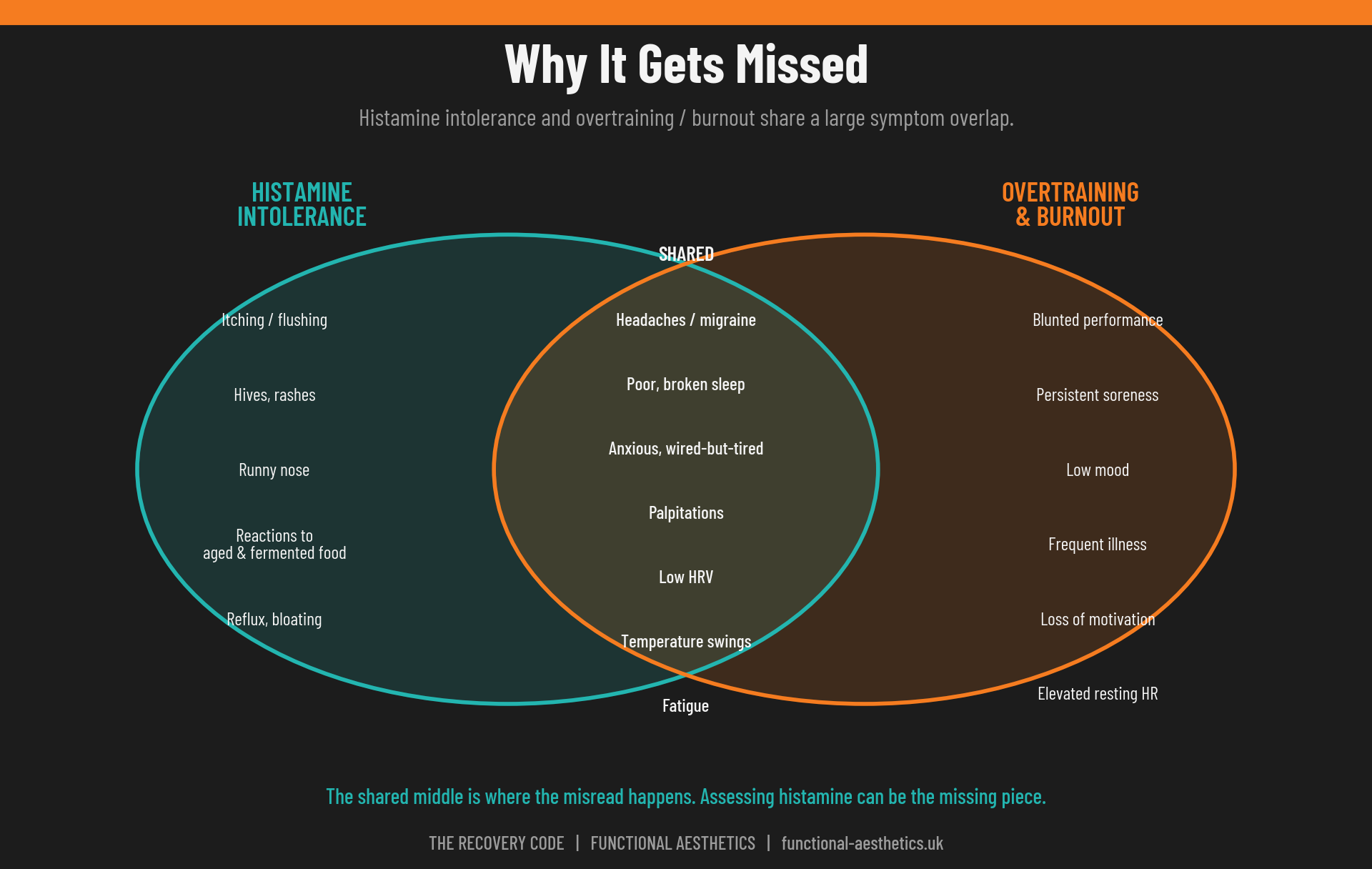
The symptoms that land in the shared middle, poor sleep, anxiety, palpitations, headaches, and a depressed heart rate variability (HRV), are exactly the markers we track in recovery. If histamine is quietly driving them, no amount of extra rest will fully resolve the picture until the histamine load is addressed.
What actually causes it: load versus capacity
The most useful way to understand histamine intolerance is as a bucket. Symptoms do not come from any single food. They appear when the total inflow overwhelms the outflow, and the bucket overflows.
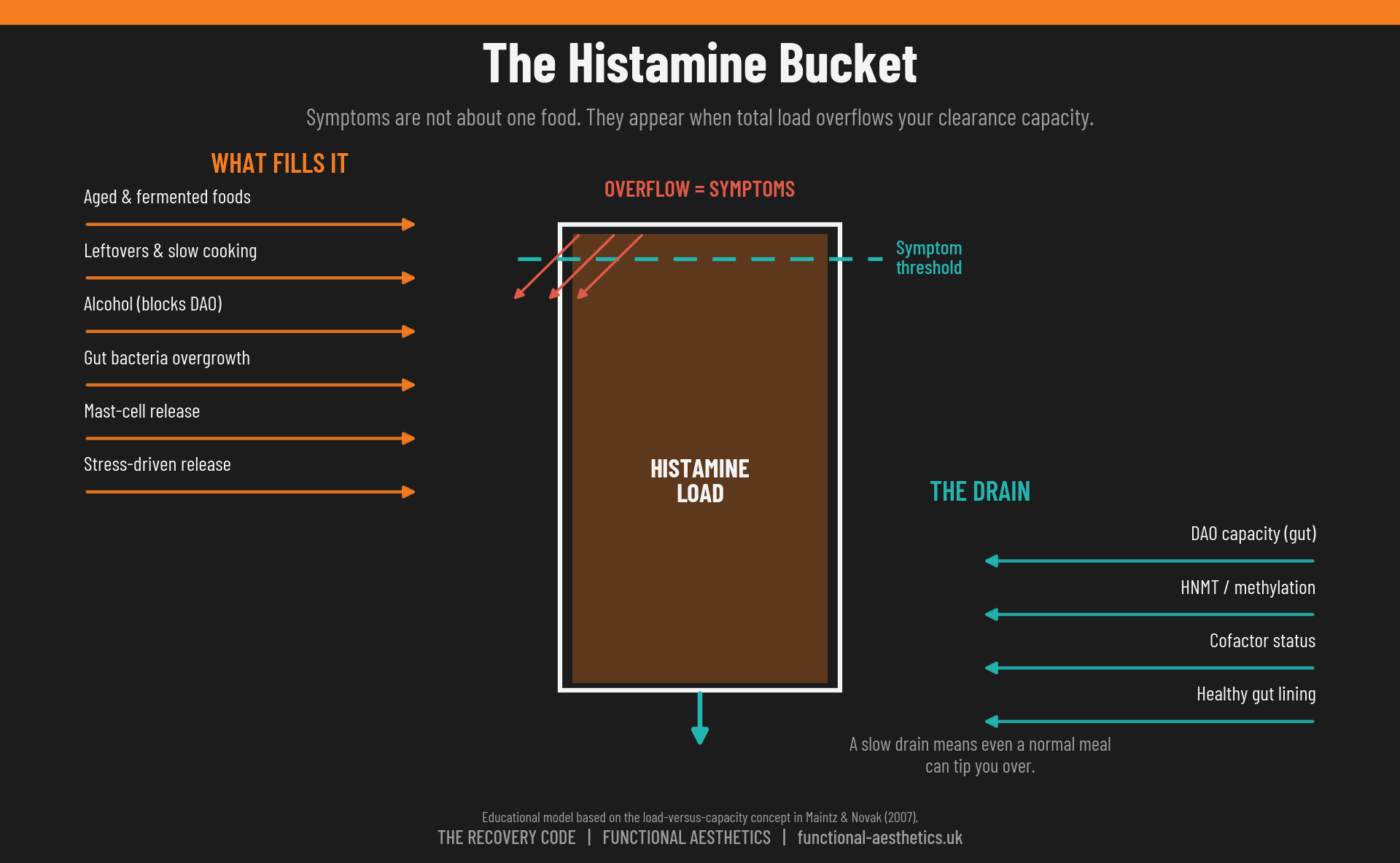
What fills the bucket includes aged and fermented foods, leftovers and slow-cooked dishes, alcohol (which also blocks the clearance enzyme), bacterial overgrowth in the gut, mast-cell release, and histamine released under stress. What drains it is your clearance capacity. When the drain is slow, even an ordinary meal can tip you over. This is why two people can eat the same dinner and only one reacts.
How the body clears histamine
There are two main clearance routes, and they matter because supporting the right one is the whole game.
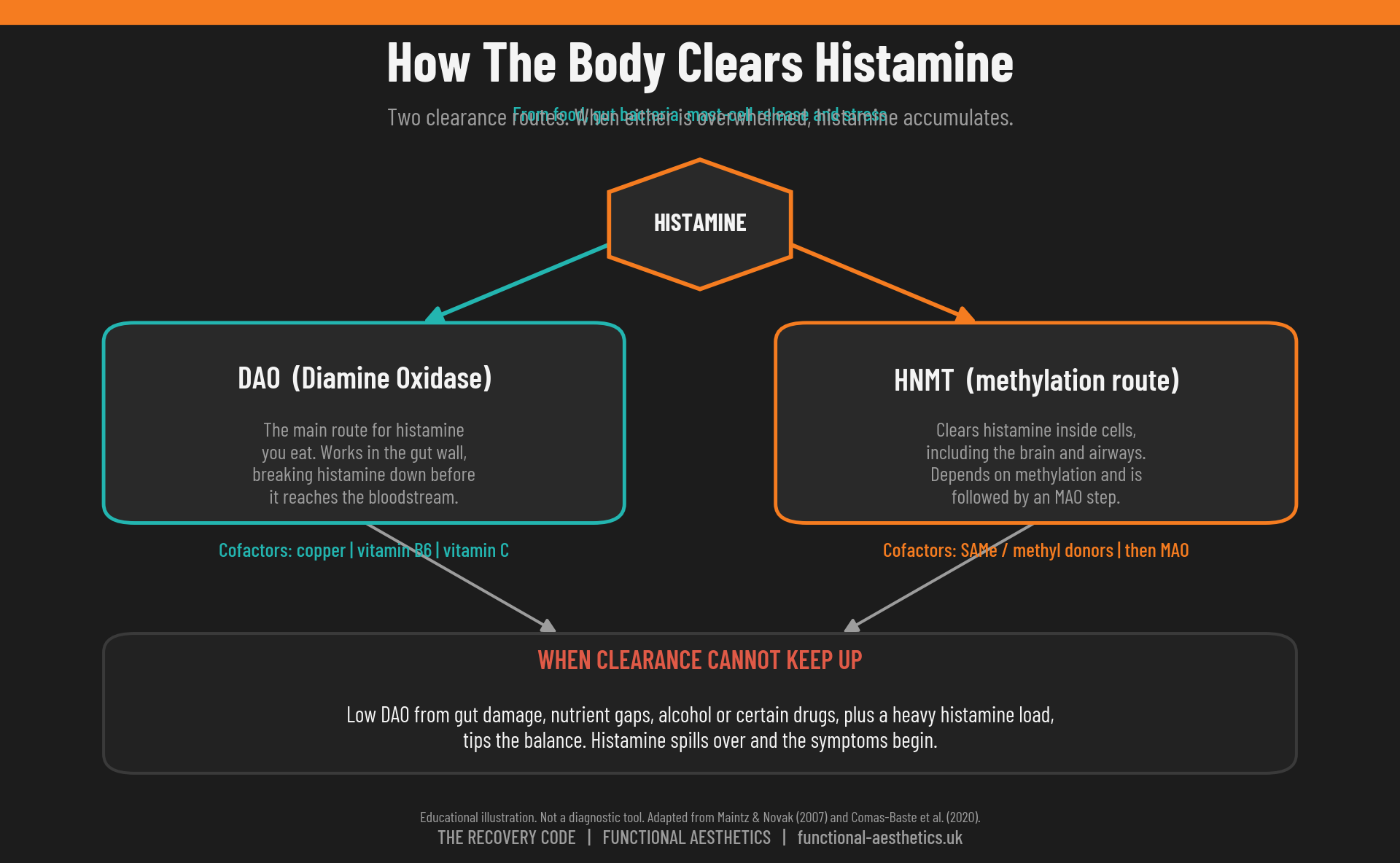
The first route is diamine oxidase, or DAO. This is the main enzyme for the histamine you eat, working in the gut wall to break it down before it reaches the bloodstream (Maintz & Novak, 2007). DAO depends on nutrient cofactors including copper, vitamin B6, and vitamin C. The second route is HNMT, a methylation-dependent enzyme that clears histamine inside cells, including in the brain and airways, followed by a further step. When either route is compromised by a damaged gut lining, nutrient gaps, alcohol, certain medications, or a genuinely heavy load, histamine spills over and symptoms begin.
The gut connection: where recovery and histamine meet
Histamine intolerance very often begins in the gut (Schnedl & Enko, 2021). This is the point where it collides directly with the recovery work I write about in The Recovery Code. Chronic stress and elevated cortisol degrade the gut lining. A compromised gut lining means lower DAO capacity and more bacterial histamine production. The result is a slower drain on the bucket, exactly when a stressed body is producing more histamine to begin with.
In my own case, the cascade was invisible to me at the time. Constant psychological stress produced chronically elevated cortisol, and that cortisol was quietly damaging my gut lining. The gut-brain axis then fed inflammation and stress signalling straight back into the loop: stress damages the gut, the damaged gut creates inflammation, inflammation worsens the stress response, and the cycle repeats. Histamine sits right in the middle of that loop.
The overtraining and HPA axis link
Histamine is not only an allergy molecule. In the brain it acts as an arousal and wakefulness signal, and its release is increased by stressors (Brown et al., 2001). That single fact explains a lot of what overtrained and burnt-out people describe. If histamine is running high, you get the classic wired-but-tired state: exhausted but unable to switch off, lying awake with a racing heart, waking at three in the morning, and watching your HRV fall.
This is the same autonomic and HPA axis picture that defines overtraining syndrome. When the stress system and the histamine system are both dysregulated, they amplify each other. You cannot fully calm the nervous system while histamine keeps pushing arousal, and you cannot easily lower histamine while the stress response keeps triggering its release. Recognising this overlap is often the difference between a recovery plan that stalls and one that finally moves.
The warning signs I missed
In the two months before my complete crash, I had three severe bouts of acid reflux. Foods I had eaten happily for years, anything mildly spicy or exotic, suddenly caused painful episodes lasting a week. During each bout my HRV dropped to 26. Alongside this came random tingles, unexplained shivers, and hot flushes that seemed to come from nowhere.
I dismissed all of it as stress-related digestive trouble and a frazzled nervous system. I was, in hindsight, only half right. New reactions to foods you have always tolerated, flushing, reflux, and autonomic instability are also a textbook histamine picture (Maintz & Novak, 2007). I had the recovery framework, but I had not yet joined that dot. That is precisely why I now flag it early.
How histamine intolerance is assessed
There is no single definitive test. Histamine intolerance is assessed as a pattern and largely by exclusion, which is another reason it slips through (Hrubisko et al., 2021). A careful assessment usually combines several things: a detailed symptom history, particularly reactions to high-histamine foods and alcohol; a structured trial of a lower-histamine approach to see whether symptoms settle; and functional bloods to rule out the conditions that mimic it and to check the nutrient cofactors that clearance depends on.
This is where a proper functional blood chemistry review earns its place. Rather than a single marker, it maps the wider terrain: inflammatory signals, nutrient status, gut clues, and the stress and metabolic markers that sit around the histamine picture. It also helps exclude the other explanations for the same symptoms, so you are not treating a shadow.
Evidence-led ways to reduce the load
The strategy is simple to state: lower what fills the bucket and improve what drains it. The following are educational options, not a prescription, and the right combination depends on the individual.
- Lower the dietary load first. A time-limited lower-histamine approach, reducing aged, fermented, and slow-cooked foods and alcohol, is the usual starting point and doubles as a diagnostic trial. It is meant to be temporary, not a life sentence.
- Repair the gut. Because the problem so often starts in the gut, this is central. In The Recovery Code I use a remove, repair, and reinoculate structure: take out the triggers, support the gut lining, then rebuild the microbiome carefully, noting that some bacterial strains raise histamine and others help clear it.
- Support the clearance cofactors. DAO depends on copper, vitamin B6, and vitamin C, so correcting genuine deficiencies matters. This is guided by testing, not guesswork.
- Consider mast-cell support. Quercetin, already part of my core recovery stack for its anti-inflammatory action, is also a well-known mast-cell stabiliser, which is why it fits this picture so neatly.
- Address the stress driver. Since stress directly increases histamine release and damages the gut, nervous system and HPA axis work is not optional here. It is part of the treatment.
- Go slowly. People in this state are often highly sensitive to interventions, so a conservative, staged approach, building up gently rather than pushing hard, tends to work far better than an aggressive protocol (Anderson, 2015).
Where this fits in your recovery plan
Histamine intolerance is rarely the whole story, but it is often the missing piece that keeps a good recovery plan from working. If your numbers say you should be recovering and your body disagrees, it is worth putting histamine on the table.
A sensible first step is to get an objective read on where your recovery actually stands. My free Recovery Readiness Calculator gives you a baseline in minutes. If the pattern in this article sounds like you, a functional blood chemistry analysis can map the terrain properly and rule out the mimics. For the full framework behind everything here, including the gut-brain and HPA axis work, you can read The Recovery Code. And if inflammation and slow recovery are the theme, my guide to hyperbaric oxygen therapy for recovery covers another evidence-led lever worth understanding.
Frequently asked questions
Is histamine intolerance the same as a food allergy?
No. A food allergy is an immune reaction to a specific trigger. Histamine intolerance is a clearance problem, where histamine builds up faster than your body can break it down. This is why the reactions are often dose-dependent and delayed rather than immediate (Maintz & Novak, 2007).
Can overtraining or burnout cause histamine intolerance?
They can certainly contribute. Chronic stress raises histamine release and damages the gut lining, which lowers your clearance capacity. So the overtrained, high-stress state and histamine intolerance tend to feed one another, which is part of why they are so often seen together.
How do I know if histamine is affecting my sleep and HRV?
Because histamine is a wakefulness signal in the brain, a high load can drive the wired-but-tired state, night waking, palpitations, and a lower HRV. A useful clue is whether these symptoms flare after higher-histamine meals or alcohol. A structured low-histamine trial, tracked against your HRV, can make the link visible. This should be interpreted alongside a proper assessment rather than in isolation.
Do I have to avoid high-histamine foods forever?
Usually not. The aim is to lower the load temporarily while you restore clearance capacity, mainly by repairing the gut and correcting nutrient gaps. As the drain improves, most people can reintroduce a much wider range of foods.
A note on medical advice
This information is educational and does not constitute medical advice. It is not intended to diagnose, treat, cure, or prevent any condition. Histamine intolerance overlaps with several other conditions that need proper exclusion, so always consult a qualified practitioner before making changes to your health protocols, especially if you have existing conditions or take medication.
References
- Maintz, L. & Novak, N., 2007. Histamine and histamine intolerance. American Journal of Clinical Nutrition, 85(5), pp.1185-1196.
- Comas-Baste, O. et al., 2020. Histamine intolerance: the current state of the art. Biomolecules, 10(8), p.1181.
- Schnedl, W.J. & Enko, D., 2021. Histamine intolerance originates in the gut. Nutrients, 13(4), p.1262.
- Hrubisko, M. et al., 2021. Histamine intolerance, the more we know the less we know. A review. Nutrients, 13(7), p.2228.
- Brown, R.E., Stevens, D.R. & Haas, H.L., 2001. The physiology of brain histamine. Progress in Neurobiology, 63(6), pp.637-672.
- Anderson, P.S., 2015. Neuroinflammation: the role of histamine and other triggers in the CNS. Clinical education seminar.